An AI phone answering service handles a configured conversation when someone calls your business. The useful question is not whether it can sound convincing, but whether the caller's request reaches the right next step.
Before choosing a provider, distinguish answering a question, taking a message, transferring a call and saving an appointment. These are different outcomes. A spoken confirmation is not proof that another system was updated.
How the call flow works
Start by deciding when calls should reach the service: while your team is busy, outside your opening hours, or under another agreed routing rule. Confirm that your phone provider supports the proposed forwarding arrangement and check its charges.
During a call, the service needs an approved greeting, accurate business information and clear limits. Give it a way to hand off questions it cannot answer. If a workflow depends on a calendar, practice-management system or messaging provider, test that connection separately.
For example, a booking enquiry can follow either of these paths:
- Request capture: the caller's details and preferred time reach a named member of staff, who checks availability and confirms the appointment.
- Connected booking: a supported integration creates the correct appointment in the intended diary. Verify the saved record, not just the conversation.
Neither path should be described as complete until its actual outcome has been checked.
Compare the alternatives by the task
| Option | What to check before choosing it |
|---|---|
| Voicemail | Who retrieves messages, how quickly they respond, and how callers know what happens next |
| Human answering service | Agreed hours, permitted tasks, handover details and charges |
| Remote receptionist | Availability, access to your systems and arrangements when that person is unavailable |
| AI answering service | Supported call flows, integration results, failure handling and staff oversight |
There is no universal winner. A service that reliably captures a request may be more appropriate than one that promises automatic booking but has not demonstrated it with your setup. Human services also vary; do not assume they cannot book appointments or provide after-hours cover.
What does an AI answering service cost?
Compare the whole proposed setup rather than a headline subscription. Ask for the billing currency, included usage, overage rates, forwarding or number charges, setup costs and any separately priced integrations. Confirm cancellation and trial terms in writing.
For VoiceFleet, use the current pricing page and confirm the plan that applies to your business. This guide does not promise unlimited usage, a particular free-trial period or a fixed installation deadline.
To assess value, use your own call records and staff follow-up results. Record which enquiries were answered, which required a callback and which became confirmed appointments. Do not treat every answered call as a new customer or use an assumed lost-revenue percentage.
A practical acceptance checklist
Use synthetic caller details and an agreed test environment before routing customer calls. Record the setup and the observed result for each scenario:
| Scenario | Evidence to inspect |
|---|---|
| A question about opening hours | The answer matches the business information you supplied |
| A booking request | The correct saved appointment, or an explicitly unconfirmed request delivered to staff |
| A corrected name or callback number | The final record reflects the correction |
| An unavailable appointment | No invented slot or false confirmation |
| A failed transfer or disconnected integration | The caller receives a clear fallback and staff can find the unresolved request |
| An out-of-scope question | A suitable handover rather than an invented answer |
For a dental or medical practice, the clinical team must define what should be handed over and how. Do not rely on a sales demo as proof of clinical triage, emergency recognition or guaranteed escalation. For restaurants and salons, distinguish a request for a table or treatment from a reservation actually entered in the business's system.
Review privacy before connecting customer data
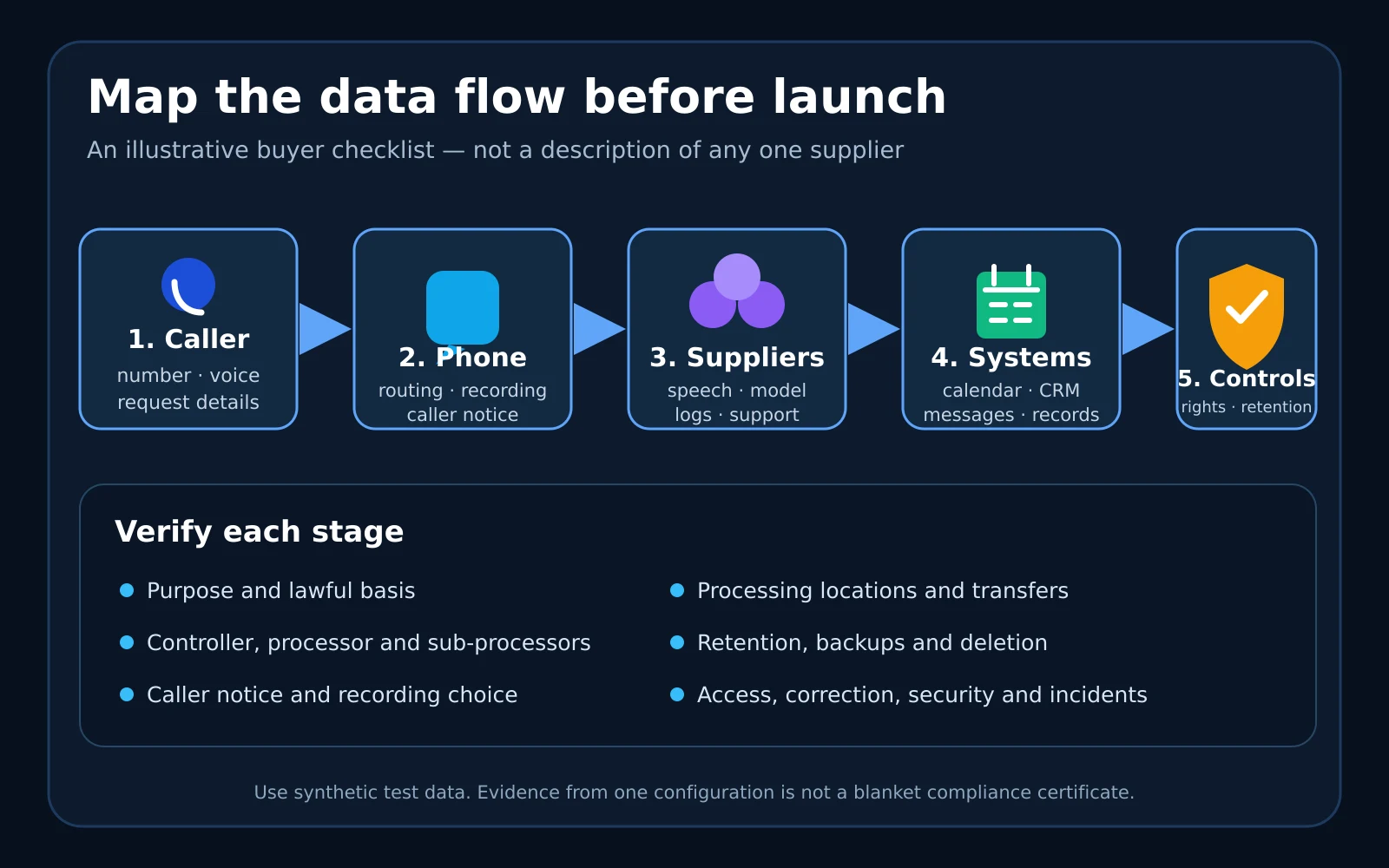
Map where call audio, transcripts, contact details and booking records go, which suppliers receive them, and how access and deletion work.
The Irish Data Protection Commission explains the controller–processor contract requirements. Its international-transfer guidance describes the transfer rules and safeguards. A supplier's address alone is not a complete compliance assessment.
Ask for the documents and configuration details relevant to your workflow. This guide is not a certification of VoiceFleet or any other provider's compliance. See our AI receptionist data-protection checklist for the questions to work through.
Evaluate VoiceFleet against your own requirements
Bring a short call script and the system you use to manage enquiries to a VoiceFleet demo. Ask us to show the supported workflow, its limits and the staff handover. If an integration or outcome has not been demonstrated, keep it marked as unverified.
Choose a controlled rollout with someone responsible for checking real results. Add further automation only after the existing workflow works as intended.
Updated 30 September 2026: removed unsupported price, trial, performance, integration and compliance assertions. Replaced blanket provider comparisons with a practical evaluation checklist. This guide does not report a completed product test or customer result.


