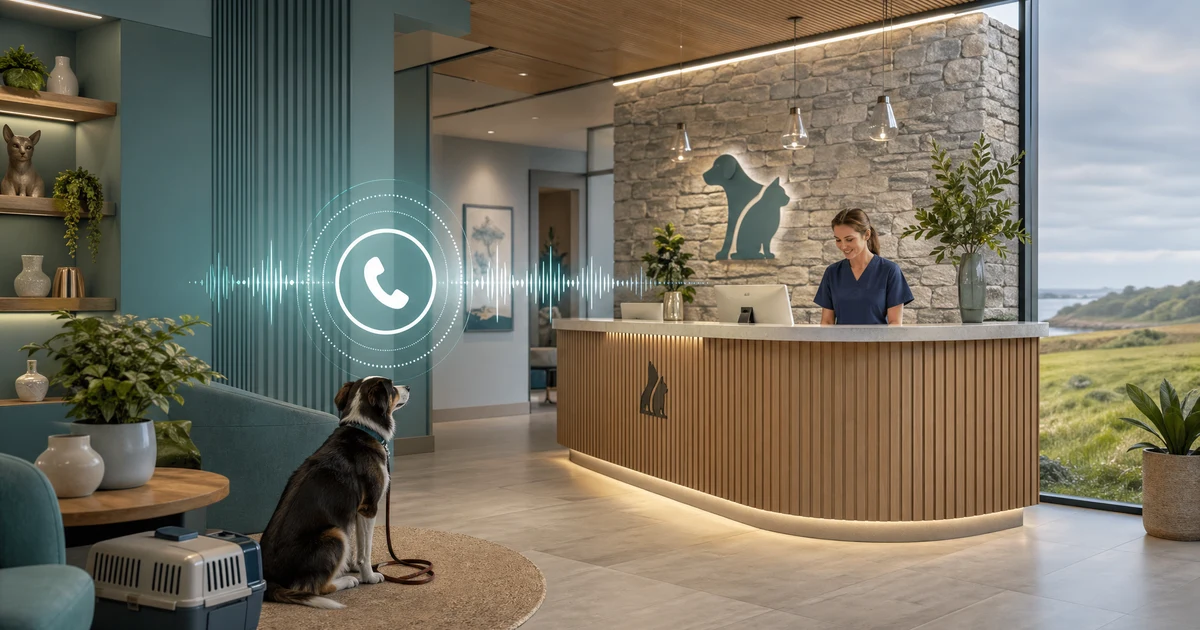
TL;DR: Veterinary clinics face a unique phone challenge — high call volumes, emotionally charged pet owners, genuine medical emergencies mixed with routine enquiries, and a chronic staffing shortage across the UK and Ireland. AI receptionists built for vet-specific workflows can handle emergency triage routing, after-hours calls, appointment booking, prescription refill requests, and multi-pet household management. With the RCVS reporting over 28,000 practising vets in the UK and the VCI registering approximately 3,600 in Ireland, the profession is stretched thin. This guide covers everything veterinary practice owners and managers need to know about implementing AI phone handling in 2026.
The Veterinary Phone Problem: Why Vet Clinics Miss More Calls Than Almost Any Other Business
Walk into any busy veterinary practice at 10am on a Monday and you'll see the same scene: two receptionists juggling ringing phones, a queue of pet owners at the desk, a nervous cat in a carrier yowling, and a vet nurse popping out to ask about a lab result. The phone rings again. Nobody can answer it.
This isn't a failure of management — it's a structural problem baked into how veterinary practices operate:
- Consultation overlap: Most calls come during morning surgery hours (9am–12pm), exactly when staff are busiest with in-clinic patients
- Call complexity: Vet calls aren't quick. A worried pet owner describing symptoms can take 5–10 minutes. Multiply that by the 40–80 calls a typical small AI receptionist for veterinary clinics practice receives daily
- Staffing crisis: The British Veterinary Association (BVA) has consistently flagged recruitment difficulties. A 2024 BVA survey found that 90% of practices reported difficulty recruiting veterinary nurses — the very staff who often cover phones
- Emotional stakes: When someone's pet is ill, being sent to voicemail feels like being ignored during a crisis. The emotional impact of a missed call at a vet clinic is far greater than at most businesses
The Royal College of Veterinary Surgeons (RCVS) maintains a register of over 28,000 veterinary surgeons practising in the UK, spread across roughly 5,000 practice premises. In Ireland, the Veterinary Council of Ireland (VCI) registers approximately 3,600 veterinary practitioners across around 900 premises. These are overwhelmingly small businesses — the average UK vet practice employs 2–4 vets and 3–6 support staff.
The result? The RCVS Practice Standards Scheme doesn't mandate phone answering standards, but client feedback data consistently shows that telephone access is the number one source of complaints across UK and Irish veterinary practices.
What Makes Veterinary Calls Different From Other Industries?
You can't simply plug a generic AI receptionist into a vet clinic and expect it to work. Veterinary calls have unique characteristics that require specialised handling:
Emergency Triage
Some calls are genuine emergencies — a dog that's eaten chocolate, a cat struggling to breathe, a horse with colic symptoms. These calls need to be identified immediately and routed to a vet or nurse, or directed to an emergency out-of-hours provider. Getting this wrong isn't just bad customer service — it could be a matter of life and death for an animal.
Symptom Description
Pet owners call describing symptoms in lay terms: "my dog is being sick," "the cat's not eating," "the rabbit seems off." The AI needs to ask appropriate follow-up questions (how long, how severe, any other symptoms, is the animal breathing normally) without providing medical advice — a crucial distinction.
Multi-Pet Households
Many clients have multiple pets registered at the same practice. When Mrs. Patterson calls, she might be ringing about Max the Labrador, Whiskers the cat, or both. The AI needs to identify which pet the call concerns and pull up the right context.
Prescription and Food Requests
A significant portion of vet clinic calls are for repeat prescriptions and prescription diet food orders. These are routine, predictable calls that follow a standard process — ideal for AI handling.
Bereavement and Emotional Calls
Euthanasia is part of veterinary practice. Calls from owners making end-of-life decisions, requesting ashes collection, or simply needing to talk after losing a pet require extraordinary sensitivity. This is one area where AI must recognise the situation and handle it with appropriate tone, or transfer to a human.
How AI Receptionists Handle Veterinary Emergency Triage
Emergency triage is the most critical function an AI receptionist performs in a vet clinic. Here's how VoiceFleet's veterinary-specific workflow handles it:
Step 1: Initial Assessment
When a caller describes a potential emergency, the AI asks a structured set of triage questions based on veterinary protocols:
- What species and breed is the animal?
- What symptoms are you seeing?
- When did this start?
- Is the animal conscious and breathing?
- Has the animal ingested anything unusual? (for toxicity cases)
- Is there any bleeding?
Step 2: Urgency Classification
Based on responses, the AI classifies the call into one of three categories:
- Red — Immediate emergency: Difficulty breathing, collapse, seizures, suspected toxin ingestion, severe trauma, bloat symptoms in large breed dogs. Action: immediate transfer to vet/nurse on duty, or direct to emergency OOH provider with a warm handover message.
- Amber — Urgent, same-day: Vomiting for more than 24 hours, limping with pain, eye injuries, minor wounds. Action: book urgent same-day appointment, flag to clinical team.
- Green — Routine: Ongoing mild symptoms, vaccination enquiries, check-up requests. Action: book standard appointment at next availability.
Step 3: Handover or Booking
Red calls are transferred immediately. The AI provides the receiving vet or nurse with a brief summary: "Incoming call — 4-year-old Labrador, suspected chocolate ingestion approximately 2 hours ago, 200g dark chocolate, dog is alert but vomiting. Owner: James Collins, patient: Biscuit."
This structured handover saves critical minutes compared to a panicking owner trying to explain the situation from scratch.
"The AI triage is surprisingly good. It asks the right questions and gives us a clear summary before we even pick up the transfer. We've had cases where the structured information from the AI actually helped us prepare treatment faster." — Practice manager, mixed animal practice, County Cork
After-Hours Call Handling: The 16 Hours Your Clinic Is Closed
Most vet clinics in the UK and Ireland are open 8–10 hours per day, which means for the remaining 14–16 hours, calls go to voicemail or an out-of-hours provider.
The traditional model works like this: outside practice hours, calls are forwarded to an OOH emergency provider (like Vets Now in the UK or regional co-operatives). But not every after-hours call is an emergency. Many are:
- Clients wanting to book an appointment for tomorrow
- Prescription refill requests
- Questions about post-operative care following a procedure that day
- New clients wanting to register
- Calls about results that were promised "this afternoon" but the client missed closing time
An AI receptionist handles the after-hours period intelligently:
- True emergencies: Identified via triage questions and immediately transferred to your OOH provider with full context
- Appointment requests: Booked directly into your practice management system for the next available slot
- Prescription refills: Logged and queued for the vet to authorise first thing in the morning
- General enquiries: Answered from your FAQ database (pricing, services, directions, parking)
- Callbacks: Detailed messages taken with full context, prioritised for morning review
The result: when your team arrives at 8am, they have a clear, prioritised list of overnight calls rather than a voicemail box full of garbled messages. Urgent callbacks are flagged. Appointments are already booked. Prescription requests are ready for authorisation.
Appointment Booking: Integrating With Veterinary Practice Management Software
The real power of an AI receptionist comes from integration with your practice management system (PMS). In the UK and Irish veterinary market, the main systems are:
- RoboVet (Covetrus) — widely used across UK and Ireland
- Merlin — popular in UK small animal practices
- Animana — cloud-based, growing in adoption
- Teleos — used particularly in farm/mixed practices
- Vet Radar / ezyVet — newer cloud-based options gaining traction
VoiceFleet integrates with these systems via API to offer real-time appointment booking. When a client calls:
- The AI identifies the client (by phone number match or by asking their name and pet's name)
- It pulls up their record and identifies which pet needs an appointment
- It checks real-time availability against the practice diary
- It books the appropriate appointment type (consultation, vaccination, dental check, post-op review) with the correct duration
- It confirms the appointment details and sends an SMS confirmation to the client
This works during and outside practice hours. A client calling at 9pm to book a routine appointment wakes up to find a confirmed booking in their text messages — no need to remember to call back in the morning.
Prescription Refill Requests: Automating the Most Repetitive Call Type
If you work in a vet practice, you know this call. It comes in 15–30 times per day:
"Hello, I need to order more of Bella's thyroid tablets please."
The receptionist then needs to:
- Find the client record
- Check which medication and dosage
- Verify when the prescription was last dispensed
- Confirm the vet has authorised a repeat
- Let the client know when to collect
An AI receptionist handles this entire flow automatically:
- Identifies the client and pet
- Confirms the medication from the repeat prescription list
- Logs the request in the PMS for vet authorisation
- Tells the client: "That's been requested for you. Bella's Felimazole will be ready for collection after 2pm tomorrow once the vet has signed it off. We'll send you a text when it's ready."
For a practice handling 20 prescription calls per day at an average of 4 minutes each, that's 80 minutes of receptionist time freed up daily — almost an hour and a half that can be spent on in-clinic clients, clinical support, or simply reducing stress levels.
Multi-Pet Households: Managing Complex Client Relationships
The average UK pet-owning household has 1.8 pets, but many of your best clients have considerably more. Managing calls for multi-pet households requires the AI to:
- Identify the correct pet: "I'm calling about one of your pets — is this about Max, Bella, or Mr. Whiskers?"
- Handle multiple requests in one call: "While you're on, can I also book Bella in for her boosters?"
- Track separate medical histories: A vaccination reminder for one pet shouldn't be confused with a medication refill for another
- Manage shared contact details: Sometimes different family members call for different pets — the AI needs to handle Mr. Patterson calling about the dog and Mrs. Patterson calling about the cats, linking both to the same household
VoiceFleet handles this by matching the incoming phone number to the household record and presenting the pet list at the start of the call. For new or unrecognised numbers, it asks for the client surname and postcode to locate the record.
The Vet Staff Wellbeing Factor
This section matters more than you might think. The veterinary profession in the UK and Ireland faces a genuine wellbeing crisis:
- A 2023 BVA survey found that 90% of veterinary professionals reported concerns about their own or colleagues' mental health
- The RCVS Mind Matters Initiative has highlighted that constant high workload is a primary contributor to burnout and mental health issues in the profession
- Veterinary nurse attrition rates are significant — many cite relentless workload and inability to take breaks as reasons for leaving
Reception staff bear the brunt of client frustration when phone lines are busy. They're the ones apologising for long hold times, dealing with angry clients who've been trying to get through for 20 minutes, and managing the emotional weight of calls about seriously ill or dying animals — all while trying to process the queue of people standing in front of them.
An AI receptionist doesn't replace these staff. It takes the pressure off them. When the AI handles routine appointment bookings, prescription requests, and general enquiries, your reception team can focus on the in-clinic experience, support the clinical team, and actually take their lunch break.
"Our head receptionist told me she cried on the way home three times in one week because the phone just never stopped. Since we brought in VoiceFleet, she says she actually enjoys her job again. That alone was worth it." — Practice owner, 3-vet small animal practice, Surrey
Implementation: How to Set Up VoiceFleet for Your Vet Clinic
Setting up an AI receptionist for a veterinary practice is more involved than for a generic small business, because the clinical workflows matter. Here's the process:
Week 1: Configuration
- Connect VoiceFleet to your practice management system
- Configure your appointment types and durations (10-min consult, 20-min dental check, 30-min new patient, etc.)
- Set up your emergency triage protocol — define what constitutes red/amber/green
- Input your FAQ database: pricing, vaccination schedules, neutering info, registration process, parking, etc.
- Configure your OOH routing rules
Week 2: Testing
- Run test calls covering every scenario: emergency, routine booking, prescription request, new client, complaint
- Have your vets and nurses review the triage protocol — they should be comfortable with how emergencies are classified
- Test the PMS integration thoroughly — appointments should appear correctly in the diary
- Fine-tune the voice and tone — vet clients expect warmth and reassurance
Week 3: Soft Launch
- Run the AI in parallel with your existing phone setup — calls ring both the reception and the AI, and you can compare how each handles them
- Gradually shift more calls to the AI as confidence grows
- Collect client feedback — most will be positive, and the constructive feedback helps refine the system
Week 4: Full Deployment
- AI handles all incoming calls as first point of contact
- Reception staff focus on in-clinic work with overflow calls transferring to them as needed
- Monitor call analytics and client feedback weekly
Cost Analysis for Veterinary Practices
Let's look at the real numbers for a typical 3-vet small animal practice in the UK:
Current Phone Handling Costs
- 2 receptionists dedicated primarily to phone work: £22,000 × 2 = £44,000/year in salary
- Plus employer NI, pension, holiday cover: approximately £54,000/year total
- OOH telephone service (basic message taking): £150–£300/mo = £1,800–£3,600/year
- Missed calls still occurring: estimated 15–25 per day during peak periods
With VoiceFleet AI Receptionist
- VoiceFleet veterinary plan: from £89/mo = £1,068/year
- Receptionists refocused to in-clinic roles (no redundancies — they're doing clinical support, client care, and admin instead of being chained to the phone)
- OOH service potentially reduced or eliminated (AI handles after-hours with emergency routing)
- Zero missed calls, 24/7
The AI doesn't replace your reception team — it handles the phone burden so your team can do higher-value work. The financial benefit comes from capturing the revenue in missed calls and improving client retention rather than from headcount reduction.
What About the Irish Veterinary Market?
Ireland's veterinary sector has its own characteristics that make AI receptionists particularly valuable:
- The VCI registers approximately 3,600 veterinary practitioners, but the profession is heavily concentrated in mixed and large animal practice, especially in rural areas
- Many Irish practices are single-vet or two-vet operations where the vet is frequently out on farm calls — there's literally nobody in the clinic to answer the phone
- The Department of Agriculture's TB eradication programme and other regulatory obligations mean vets spend significant time on farm, creating extended periods when the clinic phone goes unanswered
- Ireland's growing pet population (estimated at over 1 million dogs registered with local authorities) means small animal workload is increasing alongside the traditional farm work
For Irish practices, an AI receptionist is often the difference between having phone coverage and having none. VoiceFleet provides Irish local numbers and can handle calls in English with an Irish-appropriate tone and vocabulary.
Frequently Asked Questions
Can the AI really handle emergency triage safely?
The AI follows a structured triage protocol that you and your clinical team configure. It does not provide veterinary advice — it asks questions, classifies urgency, and routes appropriately. Any call flagged as a potential emergency is transferred to a clinician or OOH provider immediately. The AI errs on the side of caution: ambiguous cases are escalated, not downgraded.
What if a client is very distressed — can the AI handle emotional calls?
The AI detects emotional cues (raised voice, crying, distress language) and responds with appropriate empathy and tone. For calls related to euthanasia or bereavement, the AI can be configured to transfer immediately to a team member or handle with a specifically gentle script. It won't be dismissive or robotic in these situations.
Does VoiceFleet integrate with RoboVet/Merlin/Animana?
Yes. VoiceFleet has integrations with the major UK and Irish veterinary PMS platforms. The depth of integration varies — appointment booking and client lookup are standard; clinical record access is read-only where available. Contact VoiceFleet for specifics on your system.
Will older clients be put off by an AI answering the phone?
In practice, most clients simply notice that someone answered promptly and was helpful. The voice quality in 2026 is natural enough that many callers don't realise they're speaking to AI. For those who do, the response is typically positive — they appreciate not waiting on hold. VoiceFleet can also be configured to offer an immediate transfer to a human for any caller who requests one.
Can the AI handle calls about exotic pets?
If your practice sees exotics, the AI can be configured with species-specific knowledge: common exotic pet emergencies, appropriate questions for reptile/bird/small mammal owners, and special booking requirements (e.g., longer consultation slots for exotic cases). The system is as specialised as you make it.
What about farm calls and large animal practice?
For mixed practices, the AI distinguishes between small animal calls and farm calls. Farm calls often involve herd-level issues (calving difficulties, lameness in multiple animals, bulk milk tank problems) that require different triage questions. VoiceFleet's veterinary module includes large animal triage protocols alongside companion animal ones.
How does pricing work for vet clinics?
VoiceFleet's veterinary plan starts at £89/mo and includes the full feature set: emergency triage, appointment booking, prescription handling, after-hours coverage, and PMS integration. There are no per-call charges or minute limits. Larger multi-branch practices can discuss volume pricing.
Is call data secure and compliant with veterinary regulations?
All call data is encrypted at rest and in transit, stored in European data centres, and compliant with UK GDPR. VoiceFleet provides a Data Processing Agreement as standard. Call recordings and transcripts are accessible only to authorised practice staff and can be auto-deleted after a retention period you choose.
The Future of Veterinary Practice Communication
The veterinary profession is at an inflection point. Staff shortages are real and worsening. Client expectations for accessibility and responsiveness are higher than ever. The volume of pets — and therefore the volume of calls — continues to grow year on year.
AI receptionists aren't a gimmick or a cost-cutting exercise. They're an essential tool for practices that want to:
- Provide genuinely excellent client communication without burning out their team
- Capture every potential emergency call, even at 3am
- Free up trained veterinary staff to do clinical work instead of answering phones
- Grow their client base without proportionally growing their admin overhead
The practices that thrive in 2026 and beyond will be the ones that use technology to handle the routine, so their people can focus on the extraordinary — the complex cases, the compassionate conversations, and the clinical excellence that drew them to veterinary medicine in the first place.
Ready to give your vet team their time back? Start your free VoiceFleet trial — configured for veterinary workflows, live in under a week.


